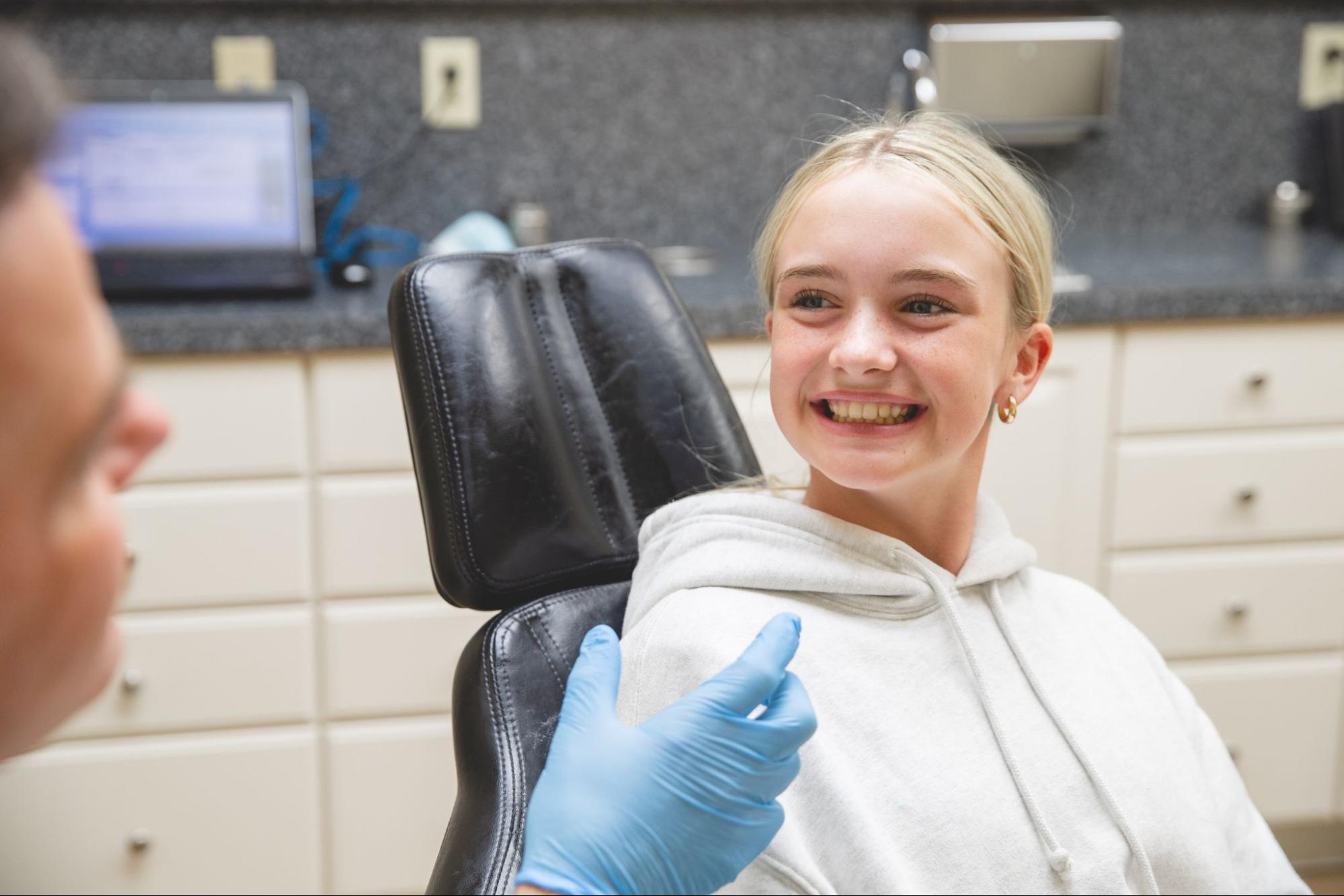
If your child’s orthodontist has mentioned a palatal expander, you probably have questions. Below, you’ll find a clear guide to how palatal expanders work, what to expect at each step, and how Byrne Orthodontics approaches expansion for growing kids, teens, and adults.

What Is a Palatal Expander?
A palatal expander is a custom orthodontic appliance that gently widens the upper jaw to correct a narrow palate, crossbite, or crowding. It attaches to the upper back molars and uses a small central screw to apply steady, outward pressure over several weeks, creating more room for teeth and better bite alignment.
Most palatal expanders are used in growing children, because the two halves of the upper jaw are still connected by a flexible seam called the midpalatal suture. That seam typically fuses in the early teen years, which is why timing matters so much. Getting ahead of that fusion window often means expansion can be achieved without more involved procedures later on.
Here’s what a palatal expander can do:
- Widen a narrow upper jaw
- Correct posterior crossbites
- Create space for crowded or impacted permanent teeth
- Help guide proper facial and smile development
- Reduce or eliminate the need for future extractions
At Byrne Orthodontics, Dr. Byrne and Dr. Pinckney use digital scans and a careful bite analysis to decide whether an expander is the right starting point for your child’s personalized treatment plan.
How a Palatal Expander Works, Step by Step
A palatal expander works by applying steady, controlled pressure to the two halves of the upper jaw, slowly separating them at the midpalatal suture so new bone can fill in the gap. The process is gradual, predictable, and guided by small daily turns of a key.
Here’s what happens, step by step:
- Fitting the appliance. Dr. Byrne and Dr. Pinckney place custom bands around the upper back molars and cement the expander in place. It sits snugly against the roof of the mouth.
- Daily activation. You (or your child, with help) use a small key to turn the central screw once a day, usually at home. Each turn moves the appliance a fraction of a millimeter.
- Suture separation. That daily pressure gradually opens the midpalatal suture, the natural growth seam between the two halves of the upper jaw.
- A temporary gap appears. A small space often opens between the two front teeth. This is a good sign, it means the expander is doing exactly what it’s supposed to do.
- Reaching the target width. Once the planned width is achieved, usually after a few weeks of turns, activation stops.
- Retention phase. The expander stays in place for several more months while new bone fills in and stabilizes the result. The gap between the front teeth usually closes on its own as the surrounding teeth drift together.
Most kids feel pressure for a few minutes after each turn, not discomfort. That sensation fades quickly, and daily life goes right back to normal.
Benefits of Palatal Expansion
Palatal expansion does more than widen a smile. When done at the right age, it can shape the foundation for a healthier bite, straighter teeth, and simpler orthodontic treatment down the road.
Here are the main benefits our patients see:
- Corrects crossbites. When upper teeth sit inside the lower teeth, chewing and jaw growth can be thrown off balance. Expansion brings the arches back into proper alignment.
- Creates room for crowded teeth. A wider arch gives permanent teeth the space they need to come in straight, which often reduces or eliminates the need for extractions later.
- Helps impacted teeth erupt. Blocked canines and other stuck teeth often have a much better chance of coming in naturally once there’s enough room.
- Can improve nasal airflow. For some kids with narrow upper jaws, widening the palate also opens up the nasal passages, which may support easier breathing.
- Shortens later treatment. Starting with a well-aligned foundation often means braces or Invisalign treatment is faster and more predictable in the teen years.
- Supports balanced facial growth. A properly developed upper jaw helps the mid-face and smile develop in harmony.
How does expansion correct crossbites?
A crossbite happens when the upper arch is too narrow for the lower arch, causing some upper teeth to bite inside the lowers. Left alone, that mismatch can wear enamel unevenly, shift the lower jaw to one side during chewing, and even influence facial symmetry over time. By gently widening the upper jaw at the midpalatal suture, expansion lets the upper arch sit properly outside the lower teeth again. Once the arches line up, chewing feels more balanced, and the jaw joint can function in a more natural resting position. Many kids also find that brushing and flossing become easier when teeth are no longer locked into an awkward bite.
Can expansion improve breathing and sleep?
For children with a narrow, high-arched palate, the floor of the nose can be constricted, which may contribute to mouth breathing, snoring, or restless sleep. Widening the upper jaw expands the base of the nasal cavity at the same time, which can make nasal airflow easier for some kids. While expansion isn’t a cure-all for airway issues, it’s often part of a broader plan that may involve an ENT, a sleep specialist, or myofunctional therapy. Dr. Byrne and Dr. Pinckney look at the whole picture during your free consult to see whether expansion might play a helpful role.
The American Association of Orthodontists recommends a first orthodontic check-up by age 7, and one of the main reasons is to catch narrow upper jaws and crossbites while expansion is still an easy option. Dr. Byrne and Dr. Pinckney use that early visit to spot small issues before they become bigger ones.

Types of Palatal Expanders Compared
Not every palate is the same, and neither is every expander. The right choice depends on age, jaw anatomy, and the specific bite issue being addressed. Dr. Byrne and Dr. Pinckney will walk you through the options at your free consult.
Here’s a quick comparison of the most common types:
| Expander Type | How It Works | Best For | Pros | Considerations |
|---|---|---|---|---|
| Rapid Palatal Expander (Hyrax) | Fixed appliance with a central screw, daily turns | Children and preteens with narrow upper jaws | Fast, predictable results | Noticeable at first; speech adjusts in a few days |
| Haas Expander | Fixed, similar to Hyrax, with acrylic pads against the palate | Younger children needing extra stability | Distributes pressure evenly | Acrylic can trap food; requires careful cleaning |
| Quad Helix | Fixed wire appliance with four helical loops | Mild to moderate expansion, often younger kids | Gentler, slower force; no daily turns needed | Slower results than a Hyrax |
| Removable Expander | Plastic appliance you take out for cleaning | Older children with mild expansion needs | Easy to clean; less visible | Only works if worn consistently |
| MARPE / MSE | Mini-implant assisted, anchored to the bone | Teens and adults with fused sutures | Avoids surgery in many adult cases | More complex placement |
For adults whose midpalatal suture has fully fused, a MARPE (mini-implant assisted rapid palatal expander) or a surgically assisted expansion (SARPE) may be recommended. Dr. Byrne and Dr. Pinckney will help you understand which path fits your anatomy best.
Who Is a Candidate for a Palatal Expander?
The best candidates for a palatal expander are children between ages 7 and 14 with a narrow upper jaw, crossbite, or significant crowding. The American Association of Orthodontists recommends that every child have a first orthodontic check-up by age 7, which is exactly when these issues are easiest to spot and treat.
You or your child may be a good candidate if:
- There’s a posterior crossbite (upper back teeth bite inside the lower teeth)
- The upper jaw looks narrow or V-shaped
- Permanent teeth are coming in crowded or blocked
- There’s a family history of narrow arches or impacted canines
- Breathing or sleep concerns point to a constricted palate
Teens may still qualify for traditional expansion if the midpalatal suture hasn’t fully fused. For adults, Dr. Byrne and Dr. Pinckney often recommend MARPE or a surgical option, since the upper jaw bones have typically knit together by the late teens.
Every evaluation at Byrne Orthodontics includes a thorough exam, digital scans, X-rays as needed, and a bite analysis. Dr. Brian Byrne and Dr. Natalie Pinckney bring both clinical expertise and the kind of warm, familiar care that keeps generations of families coming back year after year. Whether you’re exploring expansion for a young child or looking into adult options, you’ll leave your first visit with a clear understanding of what’s possible.

Frequently Asked Questions
Does a palatal expander hurt?
Most kids describe it as pressure, not discomfort. After each daily turn, you may feel tightness around the roof of the mouth or behind the nose for a few minutes, and then it fades. Over-the-counter relief is rarely needed, and the sensation gets lighter as your child gets used to the appliance.
How long is a palatal expander worn?
Active expansion usually takes a few weeks of daily turns. After that, the expander stays in place for several more months, often four to six, so new bone can fill in and stabilize the new width. Pulling it out too early would let the jaw halves drift back together.
Can adults get a palatal expander?
Yes. Adults can be treated with a MARPE (mini-implant assisted expander) that anchors directly to the bone, or with surgically assisted expansion for more significant widening. Dr. Byrne and Dr. Pinckney will evaluate your anatomy and recommend the approach that fits your smile goals.
What foods should be avoided with an expander?
Skip sticky, hard, and chewy foods that can bend the appliance or get stuck around it. That means no caramel, taffy, gum, hard candy, ice, or crunchy nuts. Softer foods, cut-up fruit, pasta, and tender proteins are easy and expander-friendly.
How do you clean a palatal expander?
Brush carefully around the expander twice a day, and use a water flosser or syringe to rinse food out from under the appliance. Rinsing with water after meals keeps things fresh between brushings. Our team will show you exactly how to clean it at your appointment.
Why is there a gap between the front teeth?
A space opening between the two front teeth is a normal and welcome sign that the expander is working. It means the midpalatal suture is separating as planned. The gap usually closes on its own in the weeks that follow, as the surrounding teeth naturally drift together.
Early evaluation is one of the simplest, smartest steps you can take for your child’s long-term smile, and it’s just as valuable for teens and adults wondering about their options. If you’re curious whether expansion might be part of creating healthy, beautiful smiles for life for someone in your family, a free consult with Dr. Brian Byrne and Dr. Natalie Pinckney is a relaxed, no-pressure way to learn more and build a personalized treatment plan that fits your goals.